How to Start Running
It is well-documented by the greatest musicians, poets, writers and athletes that getting started on any new endeavour, is often the most difficult step.
Now more than ever, it is all too easy to be paralysed by the sense that everyone in the whole entire world is fitter, stronger, smarter and prettier than ourselves, all without any effort, sacrifice or struggle to get to their destination of uptime success.
However, in the words of Mohammed Ali, “even the greatest was once a beginner…”
The key to starting any journey is simple that: to start. “If you want something you’ve never had, you must be willing to do something you’ve never done.” You will never be able to complete that 5km ParkRun or 50km ultramarathon without taking the first step in beginning to run. Counter to the word itself, one of the most tried and tested methods for running is walking, via the run-walk method.
Walk to Run
The Walk Run Method - whereby running is introduced to novice runners via increments of alternating running and walking - has been practised by beginner and professional athletes for years. It is woven into the plans of runners of all abilities and circumstances, from runners returning from injury to elite athletes optimising their VO2 max through interval sessions. However, in the sense of a way to introduce running to beginners, it really become mainstream in the late 1990’s via the Couch to 5km plan - a plan that promises beginner runners the ability to run a 5km race within nine weeks. Since then, various apps and programs, have adopted their own version of the concept, cementing that it truly is one of the best ways to take the first steps in becoming a runner.
The Run Walk Method is exactly what it sounds like: 3-4 sessions per week in which the runner breaks up “run” time with “walking” time. In the first weeks, the ratio between running and walking is fairly similar - approximately 1:1 (e.g. 60 seconds of running, followed by 60 seconds of walking). Over a period of weeks, not only do the duration of the run intervals increase, but so too does the ratio between the running and walking intervals. The end result is longer period of time spent running, with fewer and shorter walking recoveries, until VOILA we have a runner.
The gradual increase in overall total run time not only reflects the musculoskeletal adaptations that allow the runner to withstand longer periods of running, but more importantly, the physiological changes that occur over a period of weeks to make running more streamlined, effortless and enjoyable (if you want to learn more about these adaptations, you can read a blog I posted recently here).
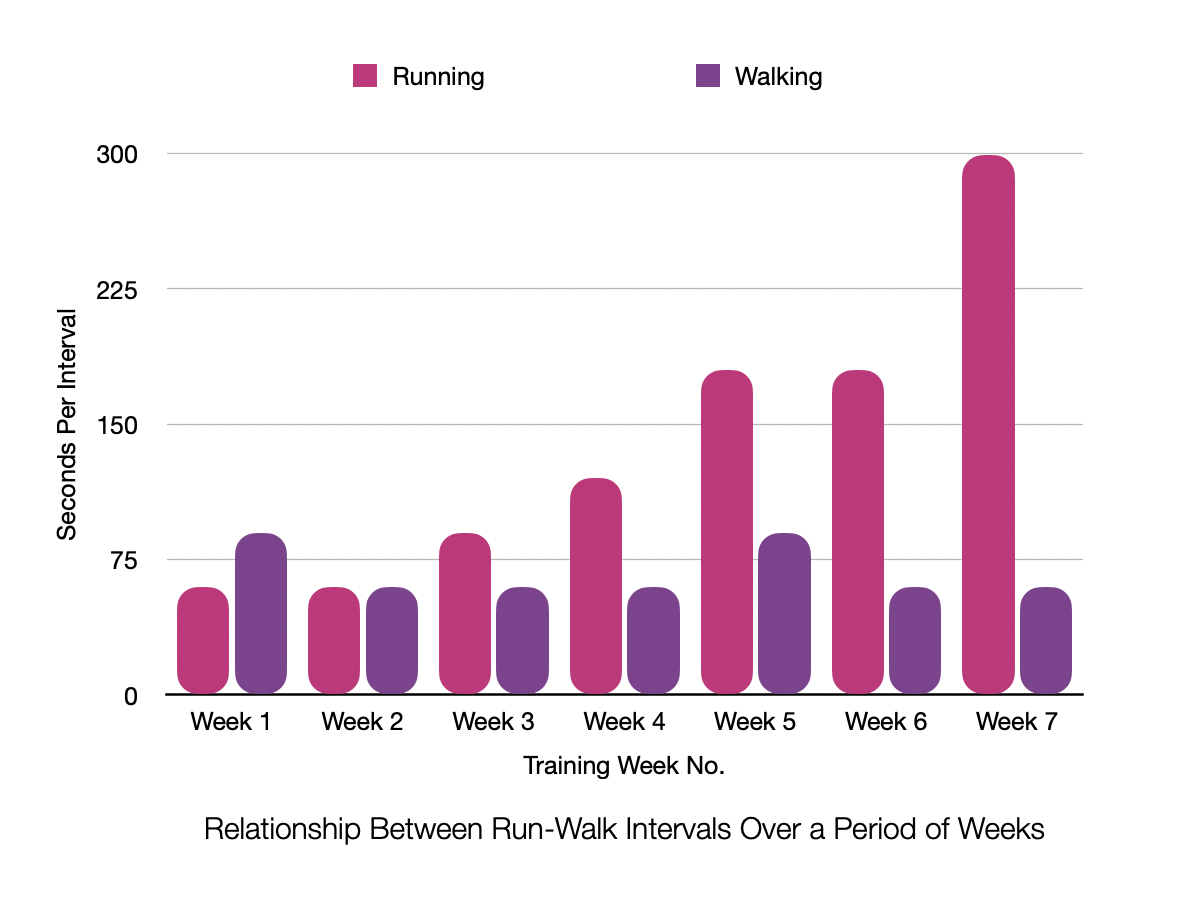
Note, graph created by myself for visual purposes only.
Benefits of the Run Walk Method
As I have explored in a previous blog (see bolded, italicised, underlined link above…), the musculoskeletal, metabolic and physiological adaptations required to make running possible occur over a period of weeks to months. Until these adaptations have solidified, running takes a lot of effort. In exchange for a lot of effort, we are too often gifted with sore shins, plantar fasciitis and a feeling of impending doom at the end of a 20 minute jog around the park. It is easy to loose hope in the long-term goal when effort is met with a sense of resistance.
However, the run-walk method helps to side-step this feeling of frustration by giving space for the adaptations required to make running more enjoyable to manifest.
This helps to minimise injury risk, fatigue and most importantly - mental burnout.
One of my favourite pieces of science comes from an article published in the Psychology of Sport and Exercise Journal in 2024. It was a study analysing which factors allowed some runners to remain consistent in the sport after six months, compared to those who lost interest and dropped out. One of the cardinal findings was that a sense of achievement, positive affirmation and progress was central to keeping runners - particularly women - in the sport. Personally, I am a big believer that momentum builds momentum, and that without the positive reinforcement that something is possible, it is almost impossible to remain consistent. The run-walk method is a way of showing new runners that they can run, albeit in small chunks at a time. In other words, running for a short amount of time, multiple times per week, is more likely to yield long-term development compared to “failing” to complete a longer effort (e.g. 30 minutes of continuous running) and subsequently giving up because of the narrative that the goal is impossible.
Benefits of the Run-Walk Method
Reduces injury risk
Allows for a gradual improvement in muscular and cardiovascular endurance
Facilitates control of effort
Minimises fatigue
Builds positive momentum and a sense of achievement, accomplishment and forward progress
I once had a situationship who embodied the quote, “go out hard, blow up early.” Perhaps this is why for the entirety of our eighteen-months of ?being together, he was sidelined from running with continuous injuries and energy deficiency (perhaps also, this is why things never worked out between us). The run-walk method is the antithesis to this philosophy. It is a way of starting to run without the risk of blowing the lid of your ambitions before arriving at first base. It is a way to acknowledge that running is difficult, and that becoming a runner demands a certain level of respect for your body. It is a method that has been tried and tested for decades by beginner and elite runners alike, and may be the first step in allowing you to manifest that dream of running across a finish line of your choosing.
TLDR
Walk-run intervals are a way to introduce running gradually and safely.
It involves alternating periods of running and walking, beginning with a time ratio of approximately 1:1 (e.g. 60 seconds of running, followed by 60 seconds of walking).
Over a period of weeks, not only do the duration of the run intervals increase, but so too does the ratio between the running and walking intervals.
Benefits of walk-run include: reduced injury risk, gradual improvement in muscular and cardiovascular endurance, better control of effort, minimisation of fatigue and a positive sense of achievement, accomplishment and forward progress. The final point is imperative to remaining in running for the long term!