Cadence
Cadence is essentially how many steps you take per minute whilst running or walking. If our bodies were a metronome, cadence would be that monotonous tick that strikes a few times per second, driving us forward.
When it comes to improving running form, reducing injury risk and maximising running economy, little interventions neither are as easy to change nor effective as optimising one’s cadence.
Each person has an innate “rate” at which they will move their legs whilst running. This is called spontaneous cadence, and for non-elite / everyday runners, this normally sits in the realm of 150-170 beats per minute. Whilst this might sound quick, it is not quite as quick as what has been deemed the “ideal” cadence. Elite and well-trained runners tend to have a slightly quicker cadence - between 170-180 beats per minute. The difference in these two scenarios is the difference between Mr. Brightside (by The Killers) and They Don’t Care About Us (by Michael Jackson).
For reference…
150 bpm - Mr. Brightside (The Killers)160 bpm - Shake It Off (Taylor Swift)170 bpm - Bad Romance (Lady Gaga)180 bpm - They Don’t Care About Us (Michael Jackson)
That’s right. If your cadence is aligned with Shake It Off, that cadence is too slow, girlfriend! It’s time to wind those twinkle toes up to the 180’s and back to the 80’s with MJ.
As mentioned above, the benefits of running with a slightly quicker cadence are many, and include:
Improved running form
Reduced risk of running injuries
Improved running economy
With a basic understanding of running physics, physiology and biomechanics, it is easy to understand why all of the above are true.
The Relationship Between Cadence and Stride Length
Cadence is intrinsically (and inversely) linked to stride length. Stride length is the distance between the place where one foot takes off from the ground and the place where the same foot lands on the ground ahead. Cadence is how quickly the feet move.
PACE = CADENCE x STRIDE LENGTH
Throw your mind back to that scene of Episode 3 of End of an Era. Taylor is in the gym, working out using battle ropes. She starts by moving the ropes up and down very quickly, creating many short, fast waves. She then switches to move the ropes more slowly, generating longer, slow waves.
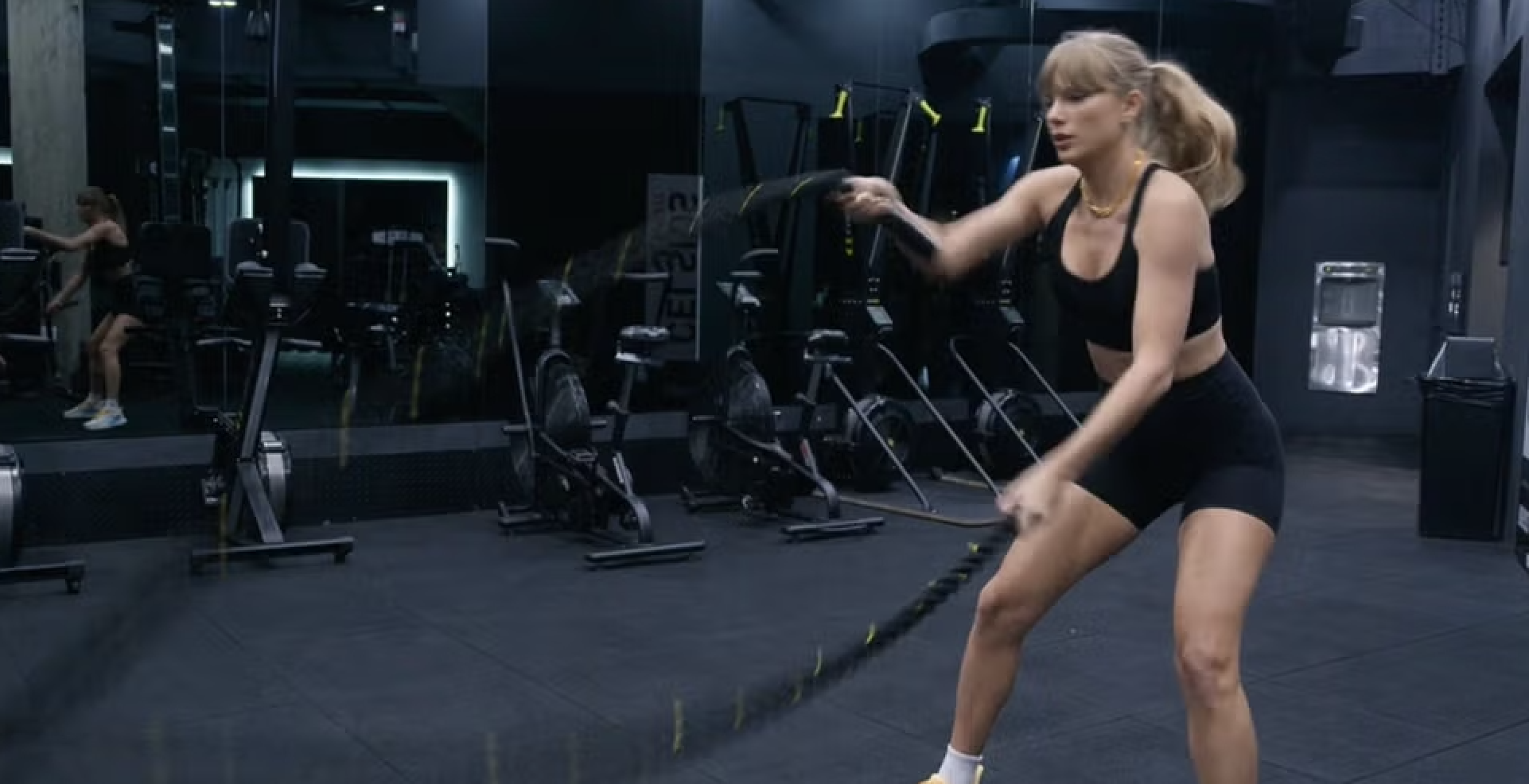
In this analogy, stride length refers to the frequency of the waves created by moving the rope. Short stride length = short waves. Long stride length = lone waves. Cadence is how quickly these waves occur. Changing one of these factors, changes the other (in the opposite direction).
Higher cadence = shorter stride length
Lower cadence = longer stride length
The Significance of Cadence
In terms of biomechanics, having a shorter stride length is typically more beneficial as opposed to longer, slower strides. This is because taking shorter, quicker steps allows the foot to strike the ground more directly beneath the hips / pelvis (closer to the centre of gravity). Doing so is also more likely to promote a forefoot / mid-foot strike of the foot as opposed to a heel strike. The combination of these factors reduces the risk of classic “runners” injuries, such as patellofemoral pain (knee pain), tibial (shin) stress fracture and medial tibial stress syndrome (shin splints).
Given that around 56% of recreational runners experience at least one musculoskeletal injury per year, it is in most people’s best interest to make changes where possible to reduce the likelihood of an injury sidelining them from the sport that they love. This is not only from a psychological perspective, but is also beneficial in terms of long term trajectory and development within the sport. Minimising the number of weeks or months away from running over a period of years can lead to massive gains in the realm of both aerobic and mechanical development. Improvements in running - be it pace, distance or time goals - are a marathon effort, not a sprint.
Studies uniformly suggest that increasing one’s cadence by 5 to 10% above their spontaneous cadence has the potential to yield all of the above benefits.
5 to 10% above 150 = 157 - 160bpm
5 to 10% above 160 = 168 - 172bpm
5 to 10% above 170 = 176 - 184bpm
However, I am a firm believer that running is an art, not a science, and so making any sort of improvement to move your cadence as close to 170-180bpm as possible is a step in the right direction.
Techniques to Optimise Cadence
Music
One of the most logical and commonly cited ways to do so is to find a playlist of songs with the beat 170-180bpm and run in time with the music. My issue with this technique is that it may take a few runs (if not a few weeks) to work towards, and adjust to, a new rhythm of running. Going from 150 to 180bpm may seem jarring and awkward at first (it did for me). My recommendation would be to listen to songs with the desired beats per minute prior to running just to get a feel of what you are working towards, and take moments during your run to be conscious of your cadence and speed up your legs to the desired pace.
In terms of mental cues to actually get those legs moving faster, I like to think of myself as being a duck floating on a lake: smooth and controlled above the surface, with legs moving quickly beneath the water. Some people recommend focusing on picking your feet “up” rather than “down,” or imagine running on coals. Whenever I feel my cadence slowing (which usually happens as I tire towards the end of a long run) I simply remind myself to have “fast feet.” These simple words remind me to move my legs a little quicker, and zaps me back into a better running rhythm.
Strides
From my experience, as well as evidence provided by science, one of the most tried and tested ways to improve cadence sustainably is to practice strides. Strides are short bursts (normally 20-30 seconds) of running around 80-90% of maximal speed whilst maintaining long-distance running form. The focus of strides should be to remain smooth, whilst turning those legs as fast as possible. If scheduling allows, it is ideal to incorporate 4-6 x 20-30 second strides per week, normally at the end of steady or recovery runs.
Other
Other effective but less common techniques include skipping / jumping rope - the fast “ups” promote that upward take off that is necessary for a quick cadence, or running downhill. If practicing the latter, it is necessary to take lots of short, quick steps, rather than lengthy strides (which can be the source of knee pain for many people).
Regardless of where you are in your running journey, being aware that cadence even exists is the first step in working towards improved running form and reduced risk of injuries. Taking steps to optimise your cadence to a goal rate of 170-180bpm is secondary to thinking about the concept in the first space. Next time you are out for a run, simply take note of how your feet feel as they twinkle along beneath you. Do you feel bogged down and heavy, as if running through custard, or quick and light as if running on air? The second option is what we all dream about and can hope to work towards, and increasing your cadence may just be the simple key to unlock this not-too-distance fantasy.